


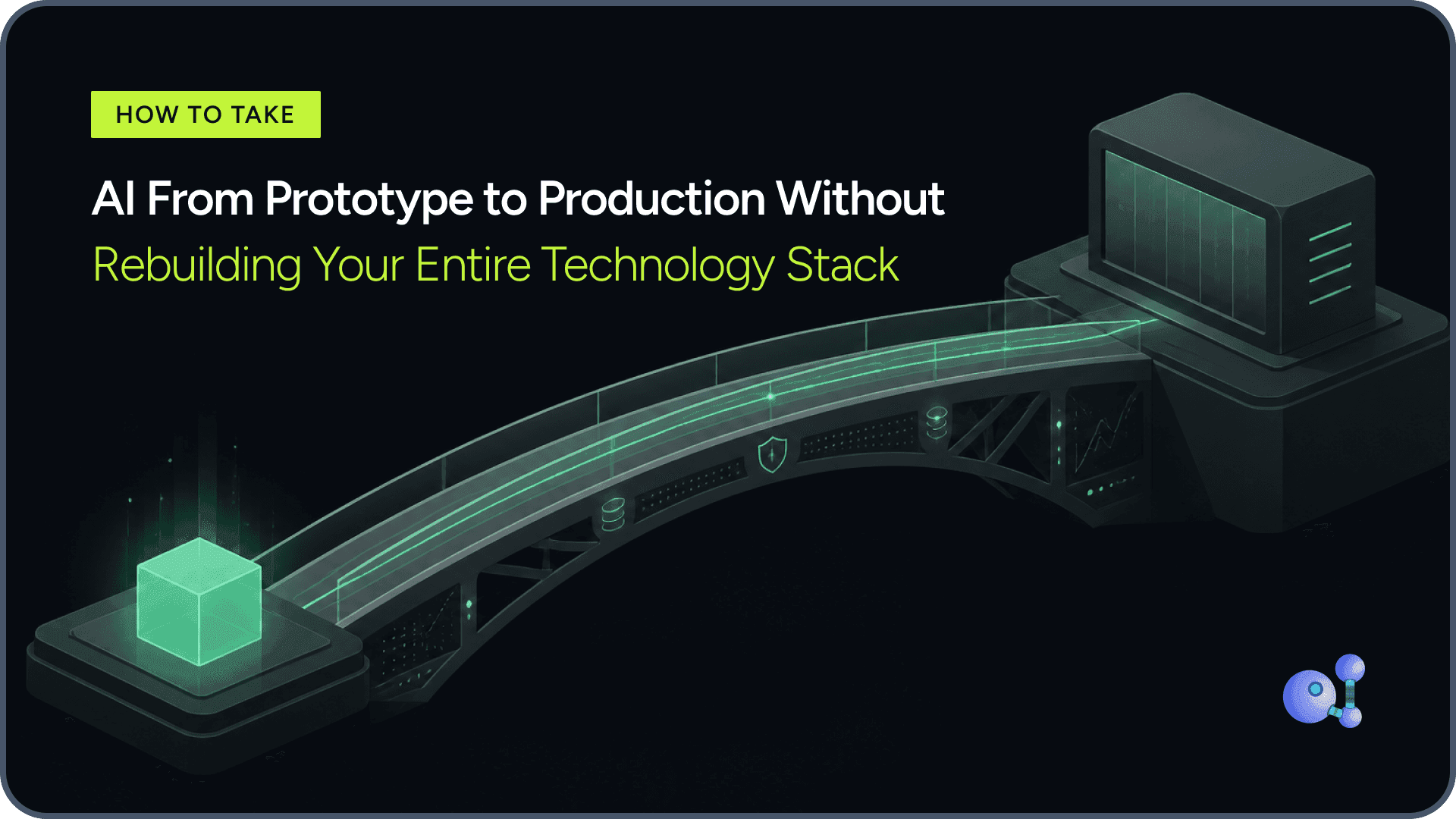
A working AI prototype answers an important question:
Can AI solve this problem?
Production introduces a much harder set of questions:
- Can it solve the problem reliably?
- Can we measure its quality?
- Can it access our data securely?
- Can it integrate with our product?
- Can we understand why it fails?
- Can it handle production traffic?
- Can we control its operating cost?
This is where many AI initiatives slow down.
The model may already work. The missing piece is often the engineering system around the model.
An AI Model Is Not an AI Product
A production AI capability can involve many components:
- Model providers
- Prompts and orchestration
- Retrieval
- Vector databases
- Enterprise data
- APIs
- Authentication
- Application logic
- Agent workflows
- Evaluation
- Guardrails
- Observability
- Cloud infrastructure
- Deployment pipelines
- Security
- Cost controls
For agentic systems, complexity can increase further.
An agent may need to reason, retrieve context, call tools, interact with enterprise applications, execute workflows, maintain state, handle failures, and operate within carefully defined permissions.
The difficult engineering problem is therefore not merely:
Which LLM should we use?
It is:
How do we engineer the complete system around the AI capability so it can operate reliably in production?
Why AI Proofs of Concept Often Get Stuck
The Data Isn't Production-Ready
A prototype can work with manually prepared documents or a small dataset.
Production systems need repeatable data ingestion, indexing, synchronization, access controls, freshness, quality management, and failure handling.
For RAG applications, retrieval quality can determine the quality of the entire system.
The AI Isn't Integrated Into the Actual Workflow
An isolated chatbot can demonstrate capability.
Business value usually appears when AI becomes part of an existing workflow—commerce operations, customer service, internal knowledge, product management, catalog operations, analytics, or decision support.
That requires application and integration engineering.
Nobody Has Defined How Quality Is Measured
Traditional software is largely deterministic. Generative AI is not.
Teams therefore need evaluation strategies appropriate to the use case.
What constitutes an acceptable response?
What failures matter most?
How are hallucinations or poor retrieval detected?
What happens when model behavior changes?
Without evaluation, teams can deploy AI without knowing whether it is actually performing well.
Production Cost Hasn't Been Modeled
Model calls, embeddings, retrieval, storage, data processing, and supporting infrastructure all have costs.
A prototype processing hundreds of interactions and a production application processing millions are economically different systems.
Security Was Deferred
Production AI may interact with sensitive business data, customer information, enterprise systems, or internal knowledge.
Identity, authorization, data boundaries, secrets, logging, tool permissions, and infrastructure controls therefore become critical.
Production AI Requires More Than AI Engineering
One of the most important lessons for engineering leaders is that production AI is multidisciplinary.
Software Engineering
The AI capability needs to exist within a maintainable application architecture.
Data Engineering
The system needs reliable access to the information required for inference, retrieval, evaluation, or automation.
Integration Engineering
AI frequently needs to interact with internal systems, APIs, commerce platforms, CRMs, databases, or external services.
Cloud & Platform Engineering
Inference, retrieval, applications, data processing, and supporting services need reliable infrastructure.
MLOps
Models, prompts, evaluations, deployments, experiments, and monitoring require lifecycle management.
Security Engineering
AI systems require controlled access to models, data, infrastructure, tools, and external systems.
Observability
Teams need visibility into latency, errors, retrieval, model usage, token consumption, application behavior, infrastructure, and cost.
This is why simply adding an AI SDK to an application is very different from engineering an AI product.
RAG Requires Engineering Beyond Connecting a Vector Database
Retrieval-Augmented Generation is frequently presented as:
Documents → Embeddings → Vector Database → LLM
Production environments are more complicated.
Engineering teams need to consider:
- Document ingestion
- Chunking strategy
- Metadata
- Indexing
- Retrieval strategy
- Permissions
- Freshness
- Re-indexing
- Ranking
- Context construction
- Evaluation
- Latency
- Observability
- Failure handling
Poor retrieval produces poor context. Poor context produces poor AI output.
The quality of a RAG application therefore depends heavily on the engineering around retrieval, not simply the underlying model.
AI Agents Introduce Another Layer of Production Risk
Agents can perform more sophisticated tasks because they can interact with tools and systems.
That also means they can do more things incorrectly.
Production agentic systems need clear boundaries around:
- Available tools
- Permitted actions
- Authorization
- Workflow state
- Validation
- Retry behavior
- Failure handling
- Human approval
- Auditability
- Observability
The more autonomy an AI system receives, the more important its engineering controls become.
Observability Is Essential
When traditional software fails, engineers investigate logs, traces, metrics, database state, and application behavior.
AI adds another layer.
Teams may also need visibility into:
- Model selection
- Prompts
- Retrieved context
- Tool calls
- Response quality
- Latency
- Token usage
- Inference cost
- Evaluation results
- Fallback behavior
Without this visibility, debugging AI systems becomes guesswork.
A Practical Production-Readiness Checklist
Before moving an AI capability into production, engineering leaders should be able to answer:
Architecture
How does AI fit into the existing application architecture?
Data
Where does context come from, and how is its quality and access controlled?
Evaluation
How do we determine whether outputs are acceptable?
Integration
Which systems, APIs, tools, or workflows must AI interact with?
Security
What data and actions can the AI access?
Reliability
What happens when the model, retrieval layer, tool, or external dependency fails?
Observability
Can engineers understand what the AI system did and why?
Scalability
What happens as usage increases?
Economics
What does the system cost per interaction, workflow, or customer?
Operations
Who owns it after deployment?
If several of these questions remain unanswered, the AI initiative may still be a prototype.
The Engineering Gap Between AI Demonstration and AI Product
AI prototypes have become easier to build. That makes the engineering surrounding them more—not less—important.
Technology companies increasingly need people who understand not only models and prompts, but how AI interacts with software architecture, data, infrastructure, security, APIs, workflows, observability, and production operations.
That is the gap SMAITIC Labs focuses on.
Our AI engineering work approaches AI as a production system, combining AI capabilities with the software, data, cloud, integration, security, and operational engineering required to make those capabilities useful in real products and workflows.